Traveling to a new country is exciting. But stepping into a taxi when you can't talk to the driver can feel daunting. You worry about getting lost or paying too much. Don't panic. With a few simple strategies, you can travel safely without speaking the local language.
Pre-Book Your Ride
The best way to skip language problems is to pre-book your taxi. Book online before you travel. Enter your pickup and drop-off locations in English. Pay in advance. The driver gets all the details before you meet.
This trick removes all stress. You do not need to explain anything. The driver knows your name and destination. They meet you with a sign. You just smile and follow them.
Pre-booking also means no language barriers. Many services offer English-speaking drivers. You provide details ahead of time. The driver already knows where to go.
In Seoul, you can book an International Taxi online. These drivers speak English, Japanese, or Chinese, and they meet you at the airport with a name sign. You can also email or call ahead to book. The service is Seoul's officially designated tourist taxi for foreigners, and drivers are proficient in the languages indicated on the vehicle.
For China, try Kiwitaxi. Book at least 16 hours before your trip for standard vehicles. The driver tracks your flight. If your plane is late, they wait. You pay a fixed price. No surprises.
In Tokyo, the NearMe Airport app offers door-to-door airport transfers and shared taxi services in the 23 wards of Tokyo. Book in advance. The driver picks you up at your door. No talking needed.
The Card Trick
The easiest trick is the hotel business card. Grab a card from your hotel front desk. Ask staff to write your destination on the back in local language.
When you enter a taxi, just hand the driver the card. Point to the address. Smile. The driver reads it and knows where to go. No talking needed.
This trick works everywhere. It saves you from mispronouncing street names. It prevents confusion between similar sounding places.
Key Phrases
Learn five simple phrases before you travel. Practice them until they feel natural.
Hello: In Japan say "Konnichiwa." In Korea say "Annyeonghaseyo." In Thailand say "Sawasdee krub."
Please take me here: In Japan say "Koko made onegai shimasu." In Korea say "Yeogi ga juseyo." Point to your card as you say it.
How much: In Japan say "Ikura desu ka." In Korea say "Eolmaeyo." This helps you understand the fare.
Stop here: In Japan say "Koko de tomatte." In Korea say "Yeogi seo juseyo." Use this when you see your destination.
Thank you: In Japan say "Arigatou gozaimasu." In Korea say "Kamsahamnida." Always end with thanks.
Drivers appreciate your effort. A smile opens doors. It shows respect.
Live Translation Apps
Your phone can talk for you. Download a translation app before your trip. These apps listen to you and the driver. They translate both ways instantly.
Google Translate is free and works in over 130 languages. Tap the conversation icon. Speak into your phone. The app shows your words in the driver's language. The driver speaks back. You see the translation in English.
This works great in taxis. You can ask about the route. You can confirm the price. You can chat about the weather. The app handles the hard part.
Download the language pack before you go. Then it works offline too. This saves data and works in dead zones.
iTranslate is another good choice. It speaks translations out loud. The driver hears the voice. This feels more natural than reading from a screen.
For Asian languages, try Papago. It handles Korean, Japanese, and Chinese better than most apps. Papago supports 14 languages including Korean, English, Japanese, and both Simplified and Traditional Chinese. It works offline and translates handwriting too.
Keep your phone charged. Bring a battery pack. These apps use power fast.
Offline Maps
Download Google Maps before you leave your hotel wifi. Search your destination. Tap the area. Select "download offline map." This saves the map to your phone.
Offline maps work without internet. They show streets and landmarks. They track your location via GPS. You do not need data or wifi.
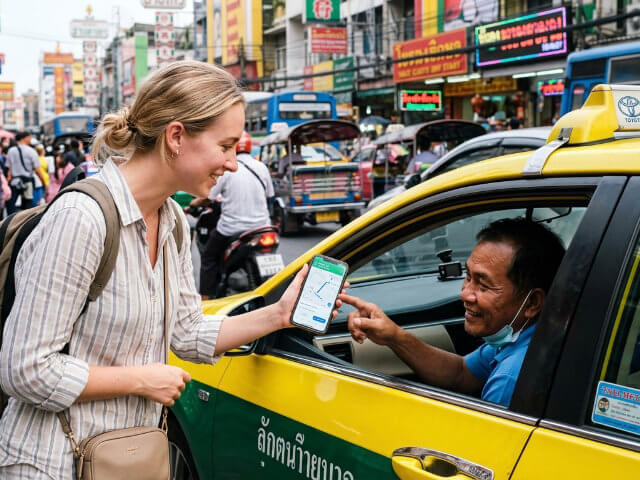
Zoom in close. Show the driver your screen. Point to the exact building. The driver sees the route clearly.
This helps when you leave the airport. Airport wifi ends at the exit. Your offline map keeps working.
Drivers can follow your map like a GPS. They see where you are. They see where you want to go. No words needed.
Use Phone Apps
Your smartphone is your best friend in a taxi. Download taxi apps before you leave your hotel. These apps show your destination to the driver without you saying a word.
Also grab a water finder app to locate drinking stations during your travels. Staying hydrated keeps you sharp for the journey ahead.
In Seoul, the Kakao T app works in English and shows the driver exactly where to go. You can see the price before you start. Kakao T is available in English and supports international credit cards.
In Tokyo, try the GO app. It calls a real taxi to your location. GO is Japan's most used taxi app, available in all 47 prefectures, and supports English, Japanese, Korean, and Simplified Chinese.
For China, download DiDi Chuxing. It now has an English mode for tourists. DiDi offers a full English interface, supports global mobile number login, and provides in-app bilingual translation between English and Chinese.
Cards Beat Maps
Maps help but cards work better. A driver can misread your phone screen in bright sunlight. But a paper card with printed text never glares.
Keep two cards in different pockets. If you lose one, you have a backup. This simple paper can save your trip.
Cards also work when your phone dies. Batteries fail. Paper does not.
Know Local Rules
Every country has different taxi rules. In Tokyo, the back door opens by itself. Do not touch the handle. The driver controls it with a button. In Japanese taxis, the rear left passenger door opens and closes automatically, operated remotely by the driver.
In Japan, taxis have a red light on the dashboard when they are free. Green means the taxi is taken. Remember this: red means stop for you. Green means keep walking. A red light indicates the taxi is vacant and available, while a green light means it already has a passenger or has been booked.
In Seoul, you can pay with credit card in most taxis. But in rural areas, cash works better. Always carry small bills.
Tokyo Tips
Tokyo taxis are super clean. They are also expensive. A ride from the airport to downtown can cost three hundred dollars. But short rides work well for groups.
Use the GO app or Uber. Both connect you to real taxis. Show the driver your hotel card. Use your Japanese phrases. Download the Tokyo offline map.
Do not tip in Japan. Drivers will return your money if you try. Tipping is not customary in Japan and can even be considered rude in many situations.
Seoul Tips
Seoul has excellent taxi apps. Kakao T is the favorite. It has full English support. You can pay with your card through the app. No cash needed.
If you hail a taxi on the street, look for the orange sign. Regular taxis in Seoul are generally orange, silver, or white. A bright red light on the dashboard or roof means the cab is available.
Use the card trick here too. Try your Korean phrases. Seoul offline maps help drivers find hidden spots.
Seoul taxis are affordable. A 10-kilometer taxi ride in Seoul averages about $8.60 USD, roughly a quarter of the cost in cities like London and Berlin.
Beijing Tips
Beijing banned Uber years ago. Now DiDi rules the roads. Uber does not operate in mainland China, as it sold its China business to DiDi Chuxing in 2016. The DiDi app offers English for tourists. You can pay with Alipay or WeChat Pay.
Street taxis in Beijing can be tricky. Some drivers do not use the meter. They might charge you too much. Always insist on the meter. Unlicensed taxis with rigged meters are a known scam in Beijing, and drivers may quote prices 3–8 times the real fare. Read our scam prevention tips to stay safe.
Have your hotel write your destination in Chinese characters. Pinyin confuses many drivers. The card trick prevents this problem. Offline maps work great here too.
Stay Safe
Trust your feelings. If a taxi looks wrong, do not get in. Use official taxi stands at airports. These stands have regulated cars.
Share your trip details with a friend. Most apps let you share your ride status. Send a screenshot of the driver's name and license plate.
Keep some cash in your pocket. Cards fail sometimes. Small bills work best. Use a currency converter to check fares in your home currency so you know what you are paying.
You Can Do This
Taking a taxi in a foreign land seems hard. But millions of tourists do it every day. Pre-book when you can. Use the card trick. Learn key phrases. Try live translation apps. Download offline maps.
Travel is about adventure. Do not let language fears stop you from exploring.